Berlin | May 2026
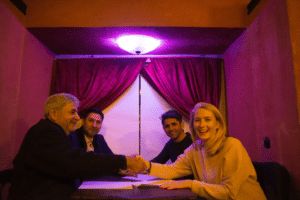
On the sidelines of the third edition of the Creative Music Lab Festival in Berlin, five cultural, human rights, and media institutions signed a Memorandum of Understanding establishing a multi-layered partnership focused on joint cultural production, exchange of opportunities, and support for Arab communities in Europe and Syria
The memorandum was signed by representatives of the participating institutions at the historic Delphi theater in Berlin: Syrian actor and activist Fares Al-Helou, co-founder of both Al-Bustan for Arts and Culture in Damascus and the Najoon Foundation based in France; director Ghassan Hammash, founder of Barzakh Foundation in Berlin; the executive director of the Czech organization BADIE, Helena Kotkova in Prague; and Jamil Nahra, founder and director of Catalonia in Arabic in Barcelona.
A partnership extending beyond traditional cultural work
The agreement is built around three main pillars: joint cultural and artistic production leveraging the cultural infrastructures and networks of the participating institutions across Damascus, Berlin, Prague, Paris, and Barcelona; exchange of opportunities between Arab artists and creators in Europe and their counterparts inside Syria during the reconstruction phase; and community support targeting the most vulnerable groups, including war victims, migrants, and Arab diaspora communities.
The memorandum comes at a moment when Syria is experiencing a cautious opening after thirteen years of conflict, while Arab cultural institutions in Europe face a dual challenge: preserving cultural memory in the diaspora and contributing to its reactivation inside Syria.
Syrian actor Fares Al-Helou, co-founder of both the Al-Bustan Foundation and the Najoon Foundation, stated that “culture is not a luxury that can be postponed until after wars, but part of rebuilding the human being itself,” adding that the goal is to “reconnect what has been broken between Syrians inside and outside the country, and between Syrian cultural memory and the spaces that hosted it in exile over the past years.”
Al-Bustan Foundation represents one of the clearest examples of this equation. It was forcibly shut down in 2011 after being seized by the security apparatus and is now working to reclaim its role as a living cultural platform in the Barzeh district of Damascus, spanning 1,500 square meters and including an open-air theatre with a capacity of 300 spectators.
An Arab network across European cities
Barzakh Foundation represents the Berlin-based pillar of this alliance. It is an open platform bringing together more than seventy artists from the Middle East, established in 2018 to bring contemporary Arab culture closer to European audiences.
Founder Ghassan Hammash said that Barzakh did not aim to remain merely an exhibition platform for Arab artists in Europe, but instead seeks to build a long-term institutional framework connecting Arab artists and cultural producers across Europe and Syria within a genuine network of cooperation and production.
Najoon Foundation works on combating impunity through intellectual, literary, and legal tools, contributing to the building of a free Syrian society.
The Czech organization BADIE adds a practical implementation dimension to the partnership through its expertise in integration and community development.
Helena Kotkova, executive director of BADIE, stated that what distinguishes this initiative is its combination of cultural and social dimensions within a practical, implementable framework, emphasizing that social integration is achieved not only through policies and services but also through culture and the creation of shared spaces between people.
Catalonia in Arabic plays the media role within this alliance, acting as a bridge between Catalonia and the Middle East and North Africa region.
Jamil Nahra, founder and director of Catalonia in Arabic, stated that Arab media in Europe should not limit itself to covering events, but should become part of building bridges and partnerships, adding that the memorandum represents a step toward building a more interconnected Arab space across the cities where the participating institutions are active.
The signing of this memorandum on the sidelines of the Creative Music Lab Festival reflects a growing transformation in Arab cultural work in Europe—from isolated individual initiatives toward institutional partnerships spanning cities and borders. It also highlights an expanding geographic and conceptual network stretching from Damascus to Berlin, Prague, Paris, and Barcelona, signaling a move toward a more interconnected Arab cultural sphere that combines artistic production, community work, and media engagement during a period of profound change in Syria and within Arab diaspora communities in Europe.
For partnerships and media collaborations: partners@catalunyaenarab.com
© Catalonia in Arabic 2026 — Reproduction in its entirety without permission is prohibited. Quotations are permitted with attribution